
Small backyards don’t mean giving up on a pool. Compare the best swimming pool options…
The Swimming Pool Tax Deduction Guide: How to Maximize Medical Write-Offs
Swimming pool tax deduction rules explained, including medical eligibility, IRS limits, and common mistakes to avoid.
Did you know that swimming pools can qualify as tax-deductible medical expenses? But before you start calculating how much you’ll save on that $50,000 investment, there’s a catch that trips up almost everyone: the IRS does allow pool deductions when a physician prescribes one for treating a specific medical condition (you can check IRS Publication 502 for the official rules), but there’s this thing called the “Appraisal Gap” rule that often wipes out your entire deduction, even after you’ve spent tens of thousands of dollars.
We’re going to walk through exactly how this works, why most homeowners end up with zero tax benefit, and what smarter alternatives exist that actually deliver the write-offs you’re hoping for.
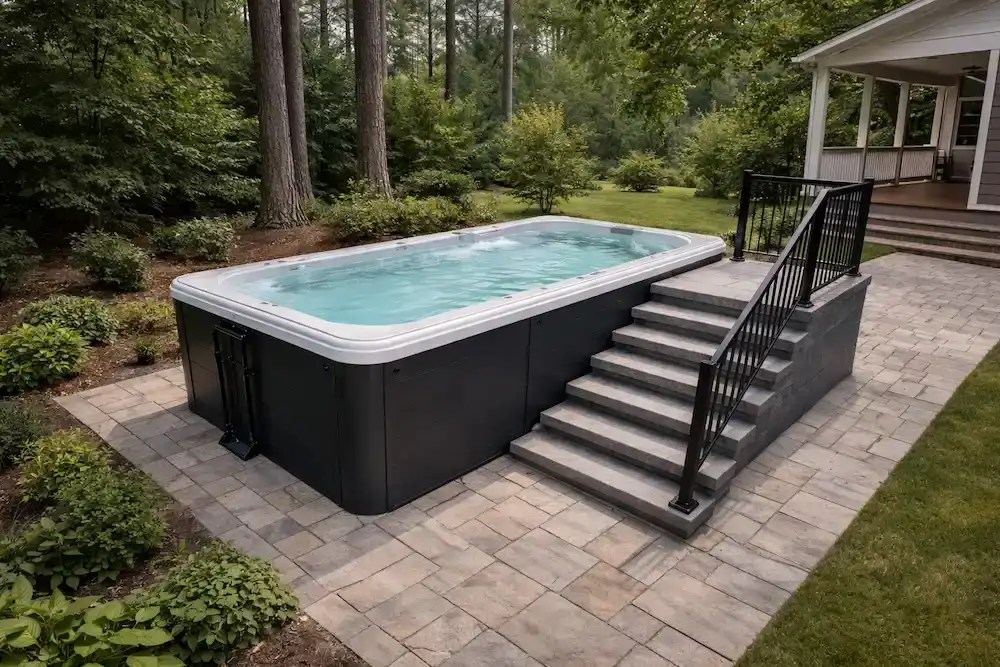
Quick heads up: We sell pools, hot tubs, and swim spas, not tax advice. For more on therapeutic water equipment, check out our guide on hot tub tax deductions.
Table of Contents
Fast Facts: Swimming Pool Tax Deductions
- Medical Necessity Required: Your doctor needs to prescribe the pool for treating a specific diagnosed condition. “You should exercise more” doesn’t cut it.
- The Appraisal Gap Formula: Your deduction equals what you spent MINUS how much your home value increased. Pool adds $50K to your home value? Your deduction just became $0.
- Portable Equipment Advantage: Swim spas often work better for tax purposes because they’re classified as portable equipment and don’t boost your property value the same way.
Can You Really Deduct a Swimming Pool on Your Taxes?
Yes, but it’s complicated. Tax advisors confirm that “if you buy a pool for medical reasons, tax law gives you a deduction for the cost of installation and for operating expenses, even though technically the pool is a capital improvement of your home.”
Let’s say you’re dealing with arthritis, fibromyalgia, chronic pain, osteoporosis, or MS. Your doctor might prescribe aquatic therapy. The rules for deducting this stuff are in IRS Publication 502, and they’re way more restrictive than you’d think.
The Medical Necessity Requirement
What tax advisors look for: “The key factor that determines the medical deductibility of a pool, spa or hot tub is that it provides a qualified medical treatment that is prescribed by a physician.”
Your doctor telling you to exercise more? That’s not going to work. The IRS wants specific medical justification tied to an actual diagnosed condition.
What Doesn’t Qualify:
There’s a case that illustrates this perfectly. “Charles Le Beau lost his pool deduction. The only evidence he could present was his personal testimony that his doctor had advised him to lose weight. He could not prove the pool was directly related to medical care.”
What Does Qualify:
In Cherry v. Commissioner, “Mr. Cherry successfully defended his pool write-off for the following reasons: The pool was prescribed by his doctor as the best form of exercise to aid with his bronchitis and emphysema… Mr. Cherry utilized the pool 2x per day for exercise.”
See the difference? Specific documentation linking the pool to diagnosed conditions, plus proof you’re actually using it for therapy.
The 7.5% AGI Threshold Explained
According to pool industry sources, “Eligible expenses must be above 7.5% of adjusted gross income (AGI) to qualify for the deduction. For example, if a couple has an AGI of $200,000, they can only deduct eligible medical expenses above $15,000.”
Here’s How It Works:
- Your household AGI: $150,000
- 7.5% threshold: $11,250
- Only expenses ABOVE $11,250 count
Plus, you have to itemize on Schedule A instead of taking the standard deduction (which is $29,200 for married couples filing jointly in 2024).
The “Appraisal Gap” Rule: Why Most Swimming Pool Tax Deductions Fail
This is where things get frustrating. The Appraisal Gap rule is the biggest reason people don’t get the deduction they’re expecting.
The IRS Formula That Changes Everything
The IRS doesn’t just let you deduct what you spent. They use the Appraisal Gap Formula that accounts for how much your home value went up: Pool Installation Cost − Increase in Home Value = Your Actual Deduction
So if you spend $50,000 on a pool and it increases your home value by $50,000, your deduction is $0.
Tax advisors break it down: “You deduct the amount of expenditure that exceeds the increase in the property value of the home. For example, let’s say that your pool costs $20,000 to install and this increases the value of your home by $8,000. This means that you can deduct $12,000 as a medical expense ($20,000 – $8,000).”
The IRS logic? If your pool makes you richer by increasing your property value, that’s an investment, not a medical expense.
The IRS is pretty clear about this: “When claiming a medical deduction for expenses that add permanent value to a home, such as a swimming pool, the taxpayer is required to obtain an appraisal of the increase in the home’s value as a result of the modification.”
A Real-World Example
In the Raleigh/Durham area, pools add serious resale value. Which is great for your home equity but terrible for your tax deduction. Our strong real estate market creates this weird situation where a nicer pool means a worse deduction.
| Item | Amount |
| In-ground Pool Installation | $65,000 |
| Increase in Home Value (Appraisal) | $55,000 |
| Potential Deduction | $10,000 |
| Less: 7.5% AGI Threshold (on $150K income) | $11,250 |
| Actual Tax Benefit | $0 |
You did everything right and still got nothing. But there’s a better way.
The Smarter Alternative: Why IRS Rules Favor Swim Spas
The Appraisal Gap rule exists because permanent improvements boost property value. But what if your therapeutic equipment wasn’t classified as a permanent improvement?
That’s where swim spas come in. Specifically, units like the Beach Club Premium offer a legitimate workaround to the problem most pool owners face.
Portable Equipment vs. Permanent Improvement
The IRS treats portable equipment completely differently from permanent improvements. Pool industry sources explain: “A portable EZ Pool, from reallyezpools.com can qualify for a tax deduction for the following reasons; it is not considered a home improvement, and, if the whole purpose of the pool is for therapy only, then it meets the standards under IRS form number 502.”
Permanent Improvement (In-ground Pool):
- Becomes part of your home’s structure
- Requires excavation and permanent plumbing
- Significantly increases property value
- Triggers full Appraisal Gap calculation
- Can’t be removed without major construction
Portable Equipment (Swim Spa):
- Classified as personal property
- Self-contained with minimal installation
- Doesn’t permanently attach to your home structure
- Adds minimal or no property value
- Can be relocated if you move
Swim Spa Deduction Example
| Item | Amount |
| Swim Spa Purchase & Installation | $35,000 |
| Increase in Home Value | $0–$5,000 |
| Potential Deduction | $30,000–$35,000 |
Important note: Classification depends on how you install it. Always confirm with your CPA. Things like permanent decking or hardwired electrical connections can affect how the IRS views it.
The Beach Club Premium Advantage
The Beach Club Premium is designed as a self-contained, portable unit. No permanent plumbing or structural modifications required, which supports its classification as personal property instead of a capital improvement.
Therapeutic features that support medical documentation:
- Adjustable current for resistance therapy: Customize exercise intensity for different conditions
- Temperature control for therapeutic warmth: Maintain consistent therapeutic temperatures year-round
- Seating designed for aquatic exercises: Ergonomic design that supports proper rehabilitation form
The Beach Club Premium is built for therapeutic use, with features that support the medical documentation your CPA needs.
Browse our swim spa collection to find options that fit your space and budget.

Pool vs. Swim Spa: Tax Treatment Comparison
| Factor | Inground Pool | Swim Spa (Beach Club Premium) |
| Typical Cost | $50,000–$100,000 | $25,000–$45,000 |
| IRS Classification | Capital Improvement | Portable Equipment |
| Home Value Increase | 40–60% of cost | Minimal to none |
| Appraisal Gap Impact | Eliminates most deduction | Preserves most deduction |
| Year-Round Therapeutic Use | Seasonal (in NC) | Year-round |
| Installation Timeline | 8–12 weeks | 1–3 days |
Check out our full swim spa collection to compare options.
Deducting Operating Costs: Chemicals, Heating, and Repairs
Even if your installation doesn’t qualify for a full deduction, operating costs can be 100% deductible every year you use it for medical purposes. This ongoing benefit often provides more cumulative tax value than the installation deduction.
Tax experts confirm: “Tax law gives you a full deduction for operation and maintenance expenses. You deduct these expenses every year that you continue to use the asset for medical purposes.”
What Operating Costs Qualify?
IRS guidance is straightforward: “Keep track of the operating and maintenance costs of your pool or any other qualified medical improvement to your residence. As long as the pool is used to treat the ongoing medical condition, you can deduct these expenses, too.”
Fully deductible operating expenses include:
- Water treatment chemicals (chlorine, pH balancers, shock treatments, algaecides)
- Heating costs (gas or electric for maintaining therapeutic temperature)
- Repairs and maintenance (filter replacements, pump repairs, cover replacements, leak repairs)
- Professional service (maintenance visits, water testing, equipment inspections)
- Electricity (pumps, heaters, filtration systems)
- Insurance (additional coverage for therapeutic equipment)
One catch: Expenses must relate to medical use. If your family also uses the pool recreationally, you’ll need to allocate costs proportionally.
Pool vs. Swim Spa Operating Costs
Traditional pools have way higher operating costs than swim spas. That means less money going toward therapy and more toward maintenance.
Typical Annual Operating Costs (Raleigh/Durham Climate):
| Expense Category | Inground Pool | Swim Spa (Beach Club Premium) |
| Heating (seasonal) | $1,200–$2,400 | $800–$1,200 |
| Chemicals | $500–$800 | $200–$400 |
| Electricity (pumps/filters) | $600–$1,000 | $400–$600 |
| Maintenance/Repairs | $800–$1,500 | $300–$600 |
| Total Annual Cost | $3,100–$5,700 | $1,700–$2,800 |
The efficiency difference matters. You spend less and every dollar you do spend on operating costs is potentially 100% deductible (subject to that 7.5% AGI threshold).
Documentation Requirements for Operating Expenses
Keep detailed records throughout the year, including:
- Receipts for all purchases (chemicals, parts, services)
- Service records (all professional maintenance visits)
- Utility bill tracking (portion attributable to pool/spa operation)
- Usage log (simple calendar noting therapeutic use dates and duration)
- Medical records (updated physician documentation confirming ongoing necessity)
Epic’s Service Advantage
Our in-house service team handles comprehensive maintenance for all equipment (even if you bought it somewhere else). This creates a paper trail of professional service records that strengthens your tax documentation.
When you work with our service and repair team, you get:
- Detailed service invoices (clear documentation of all activities and costs)
- Preventive maintenance schedules (regular service keeping equipment efficient)
- Parts and chemical tracking (complete records of all supplies)
- Professional recommendations (expert guidance on optimizing therapeutic benefits)
Schedule a service assessment for personalized operating cost estimates, or visit our Raleigh showroom for a private test soak in the Beach Club Premium.
Required Documentation: Building Your Tax Deduction Case
Pool industry experts note you need “the doctor’s prescription or recommendation, receipts for all costs associated with the pool’s construction, maintenance, and use for medical purposes, and appraisal reports before and after the pool installation.”
Medical Documentation Requirements
Your physician’s documentation is the foundation. Generic health advice won’t work here. You need specific, detailed medical justification.
Your doctor’s letter must include:
- Specific diagnosis: Exact medical condition being treated (like “severe osteoarthritis of the knees and hips” not just “joint pain”)
- Treatment prescription: Clear statement that aquatic therapy is prescribed as medical treatment
- Frequency and duration: Recommended usage schedule (like “30 minutes of aquatic exercise, 5 days per week”)
- Medical necessity explanation: Why this specific treatment is necessary for your condition
- Alternative treatment discussion: Why other options (gym pools, physical therapy facilities) won’t work
Pool industry sources confirm: “There must be a clear medical justification for the swimming pool to qualify for tax deductions. This often requires a doctor’s prescription or letter stating that the pool is necessary for treating a specific medical condition.”
Financial Documentation Requirements
You need to document every dollar spent and prove the value of the impact on your home.
Your installation cost documentation should include:
- Contractor invoices (itemized bills showing equipment, labor, materials)
- Permit fees (all municipal permits and inspection costs)
- Site preparation (excavation, electrical work, plumbing, fencing)
- Equipment purchases (pool/spa unit, covers, steps, accessories)
- Professional fees (engineering, design, consultation services)
Your property value documentation should include:
Tax guidance requires you “get an independent appraisal of your property both before and after the improvement is made”:
- Pre-installation appraisal (professional valuation before work begins)
- Post-installation appraisal (professional valuation after completion)
- Appraiser credentials (licensed, independent appraisers, not contractor-provided)
- Detailed reports (complete documents showing methodology and comparables)
Finally, your operating cost documentation should include:
- Monthly expense tracking (spreadsheet documenting all pool/spa-related costs)
- Utility bill analysis (calculate portion attributable to equipment)
- Service records (every professional maintenance visit with detailed invoices)
- Supply receipts (all chemical, parts, and accessory purchases)
- Usage log (simple calendar tracking therapeutic use dates)
Creating an Audit-Proof File
Pool industry experts recommend “preparing for potential audits by keeping thorough documentation.”
Year 1 (Installation Year) Documentation:
- Medical folder (physician letters, diagnosis records, prescription details)
- Financial folder (all invoices, receipts, payment records, financing documents)
- Appraisal folder (both pre- and post-installation appraisals with supporting documents)
- Correspondence folder (all communications with contractors, appraisers, CPA)
- Photo documentation (before, during, and after installation photos)
Ongoing (Annual) Documentation:
- Monthly expense log (updated spreadsheet with all operating costs)
- Receipt storage (physical or digital storage of all purchase receipts)
- Service records (maintenance visit summaries and invoices)
- Usage calendar (simple tracking of therapeutic use)
- Updated medical documentation (annual physician confirmation of ongoing necessity)
Working with Your CPA
Tax professionals emphasize “consulting with a tax professional to understand the implications and ensure compliance with IRS regulations” and “discussing with their healthcare provider the necessity of a pool for medical treatment.”
Questions to Ask Your CPA Before Installation:
- Does my total medical expense situation make itemizing worthwhile?
- How should I structure the purchase to maximize documentation?
- Should I classify this as equipment or improvement based on installation plans?
- What specific records do you need to prepare my return?
- How should I track ongoing operating expenses?
- What are the audit risk factors I should be aware of?
Your CPA can review documentation before filing and identify gaps or weaknesses that could trigger IRS scrutiny.
Common Mistakes That Destroy Your Deduction
After helping dozens of Raleigh/Durham homeowners navigate this process, we’ve seen the same mistakes over and over. Understanding these can save you thousands.
Mistake #1: Assuming All Medical Recommendations Qualify
The Problem: People think any doctor’s suggestion to “exercise more” or “try swimming” counts as sufficient documentation.
The Reality: The Le Beau case shows what happens: “Charles Le Beau lost his pool deduction. The only evidence he could present was his personal testimony that his doctor had advised him to lose weight. He could not prove the pool was directly related to medical care.”
The Solution: Get specific, detailed medical documentation BEFORE you buy. Your physician needs to prescribe aquatic therapy as treatment for a diagnosed condition, not just recommend general fitness.
Mistake #2: Ignoring the Appraisal Gap Until Tax Time
The Problem: Homeowners spend $50,000-$80,000 on pools expecting to deduct the full amount, then discover at tax time their deduction is zero because the pool added equivalent home value.
The Solution: Get pre-installation property appraisals and calculate your realistic deduction BEFORE committing. If the math doesn’t work, consider portable alternatives like swim spas that sidestep the Appraisal Gap problem.
Mistake #3: Failing to Track Operating Expenses
The Problem: Homeowners focus only on installation deduction and ignore ongoing operating cost deductions that can provide more cumulative value.
The Reality: Tax law allows full deductions for “operation and maintenance expenses” every year you use equipment for medical purposes.
The Solution: Start tracking from day one. Keep all receipts, maintain usage logs, document every expense.
Mistake #4: Not Consulting a CPA Before Purchase
The Problem: Homeowners make major commitments based on online research or contractor advice, then discover their specific tax situation doesn’t support the deductions they expected.
The Reality: Pool industry experts recommend “consulting with a tax professional to understand the implications and ensure compliance with IRS regulations” BEFORE making purchase decisions.
The Solution: Schedule a CPA consultation before signing contracts. Bring medical documentation, property information, and financial details for personalized guidance.
Mistake #5: Choosing Permanent Installation When Portable Would Work
The Problem: Homeowners default to traditional inground pools without considering how permanent improvement classification destroys tax benefits.
The Reality: Portable equipment like swim spas often provides way better tax treatment because they’re classified as personal property, avoiding the Appraisal Gap rule.
The Solution: Look at portable alternatives before committing. For many therapeutic applications, a high-quality swim spa like the Beach Club Premium provides equivalent or better medical benefits with dramatically better tax treatment.
Mistake #6: Inadequate Record Keeping
The Problem: Homeowners lose receipts, fail to document usage, and can’t substantiate claims during audits.
The Reality: The IRS requires comprehensive documentation, including “an appraisal of the increase in the home’s value as a result of the modification” and detailed expense records.
The Solution: Create organized filing systems from the start. Use digital tools to photograph receipts, maintain expense spreadsheets, and keep simple calendars documenting therapeutic use.
Frequently Asked Questions
Can I deduct a swimming pool if my doctor recommends it for exercise?
General exercise recommendations typically don’t qualify. Your doctor needs to prescribe aquatic therapy as treatment for a specific diagnosed condition, not just recommend general fitness or weight loss.
How much of my pool cost can I actually deduct?
The deduction formula is straightforward: Pool Installation Cost − Increase in Home Value = Your Actual Deduction.
In many cases, especially with inground pools in strong markets like Raleigh/Durham, the value increase equals or exceeds installation cost, resulting in zero deductible amount. Keep in mind, the 7.5% AGI threshold means eligible expenses must be above 7.5% of adjusted gross income in order to qualify for any deduction.
Are swim spas treated differently than pools for tax purposes?
Yes, and the difference can be huge. Portable equipment may get more favorable treatment. Because swim spas are often classified as personal property rather than permanent improvements, they typically add minimal home value, preserving more of your deduction.
Can I deduct pool maintenance costs every year?
Yes, operating expenses remain deductible annually. Tax guidance confirms: “Tax law gives you a full deduction for operation and maintenance expenses. You deduct these expenses every year that you continue to use the asset for medical purposes.” This includes heating costs, chemicals, repairs, professional service, and electricity—as long as you’re still using the equipment primarily for treating your medical condition.
What medical conditions qualify for aquatic therapy deductions?
Multiple conditions can qualify. The key is getting specific physician documentation that prescribes aquatic therapy as treatment for your diagnosed condition, not general health maintenance.
Do I need property appraisals to claim the deduction?
Yes, professional appraisals are typically required. The IRS mandates documentation showing “an appraisal of the increase in the home’s value as a result of the modification.” You need both pre-installation and post-installation appraisals from licensed, independent appraisers to calculate your actual deductible amount under the Appraisal Gap formula.
Service Without Snobbery on the Smarter Path to Relief
For many homeowners in the Raleigh-Durham area, a traditional inground pool adds too much property value to qualify as a deductible medical expense.
That’s why the Beach Club Premium Swim Spa is often the smarter financial and therapeutic choice. It offers:
- Better Tax Potential: Classified as portable equipment, avoiding the Appraisal Gap.
- Year-Round Therapy: Usable 365 days a year, unlike unheated pools.
- Lower Operating Costs: Less water, less energy, and fully deductible maintenance.
At Epic Hot Tubs, we believe in “Service Without Snobbery.” Whether you’re ready to buy or just have questions about how a swim spa fits your medical needs, we’re here to help, no high-pressure sales tactics, just honest advice from your local experts.
Ready to explore your options? Visit our showroom for a private test soak in Raleigh or Durham, or schedule an assessment for our team to evaluate your site for a smooth installation.
Disclaimer: Epic Hot Tubs and its representatives are not tax professionals. The information provided in this guide is for educational purposes only and should not be considered legal or tax advice. Always consult with a qualified CPA or tax attorney to discuss your specific medical and financial situation before making a purchase.
Ready to start planning? Contact Epic Swimming Pools for a free consultation. Serving Raleigh, Durham, Chapel Hill, Cary, and surrounding North Carolina communities.